
- “Top 10 Trends in Sustainable Construction for 2026”
Explore eco-friendly materials, energy-efficient designs, and green building certifications. - “Prefabricated vs. Traditional Construction: Which is Right for Your Project?”
Compare the pros and cons of prefabricated and conventional building methods. - “How Smart Technology is Revolutionizing the Construction Industry”
Discuss the role of IoT, AI, and automation in modern construction. - “The Benefits of Modular Construction for Commercial Projects”
Highlight how modular construction saves time, reduces costs, and offers flexibility. - “Energy-Efficient Building Materials: A Guide for Modern Construction”
Dive into materials like PUF panels, insulated concrete forms, and solar panels. - “Cold Storage Construction: Key Considerations for Efficiency and Durability”
Focus on the growing demand for cold storage facilities and best practices for building them. - “The Role of PUF Panels in Building Smart Cities”
Discuss how PUF panels contribute to sustainable and efficient urban development. - “Construction Challenges in Urban Areas and How to Overcome Them”
Address issues like limited space, noise regulations, and environmental impact. - “Innovative Roofing Solutions for Industrial and Commercial Buildings”
Cover options like PUF roofing, green roofs, and solar-integrated designs. - “How to Choose the Right Construction Partner for Your Project”
Provide tips on evaluating contractors, checking credentials, and ensuring quality. - “The Future of Construction: 3D Printing and Its Applications”
Explore how 3D printing is reshaping the construction landscape. - “Building for Extreme Weather: Materials and Techniques for Resilience”
Focus on construction methods that withstand floods, earthquakes, and high winds. - “Cost-Effective Construction Solutions for Small Businesses”
Share affordable building options for startups and SMEs. - “The Importance of Insulation in Modern Construction”
Highlight the role of insulation in energy efficiency and comfort. - “A Beginner’s Guide to Prefabricated Homes”
Educate readers on the process, benefits, and costs of prefab homes. - “Construction Safety: Best Practices for a Secure Worksite”
Discuss safety protocols, equipment, and training for construction teams. - “The Rise of Mixed-Use Developments: Benefits and Challenges”
Analyze the growing trend of combining residential, commercial, and recreational spaces. - “How to Reduce Construction Waste and Improve Sustainability”
Offer tips on recycling, reusing materials, and minimizing waste. - “The Evolution of Construction Materials: From Bricks to Smart Materials”
Trace the history and future of building materials. - “The Impact of Government Policies on the Construction Industry”
Discuss how regulations, incentives, and urban planning affect construction projects.
Let me know if you’d like me to expand on any of these topics or create content for one!
Thank you for reading this post, don't forget to subscribe!Here is a ~2500-word blog post on Top 10 Trends in Sustainable Construction 2026, written in an engaging, professional style and fully grounded in the latest research and industry insights.
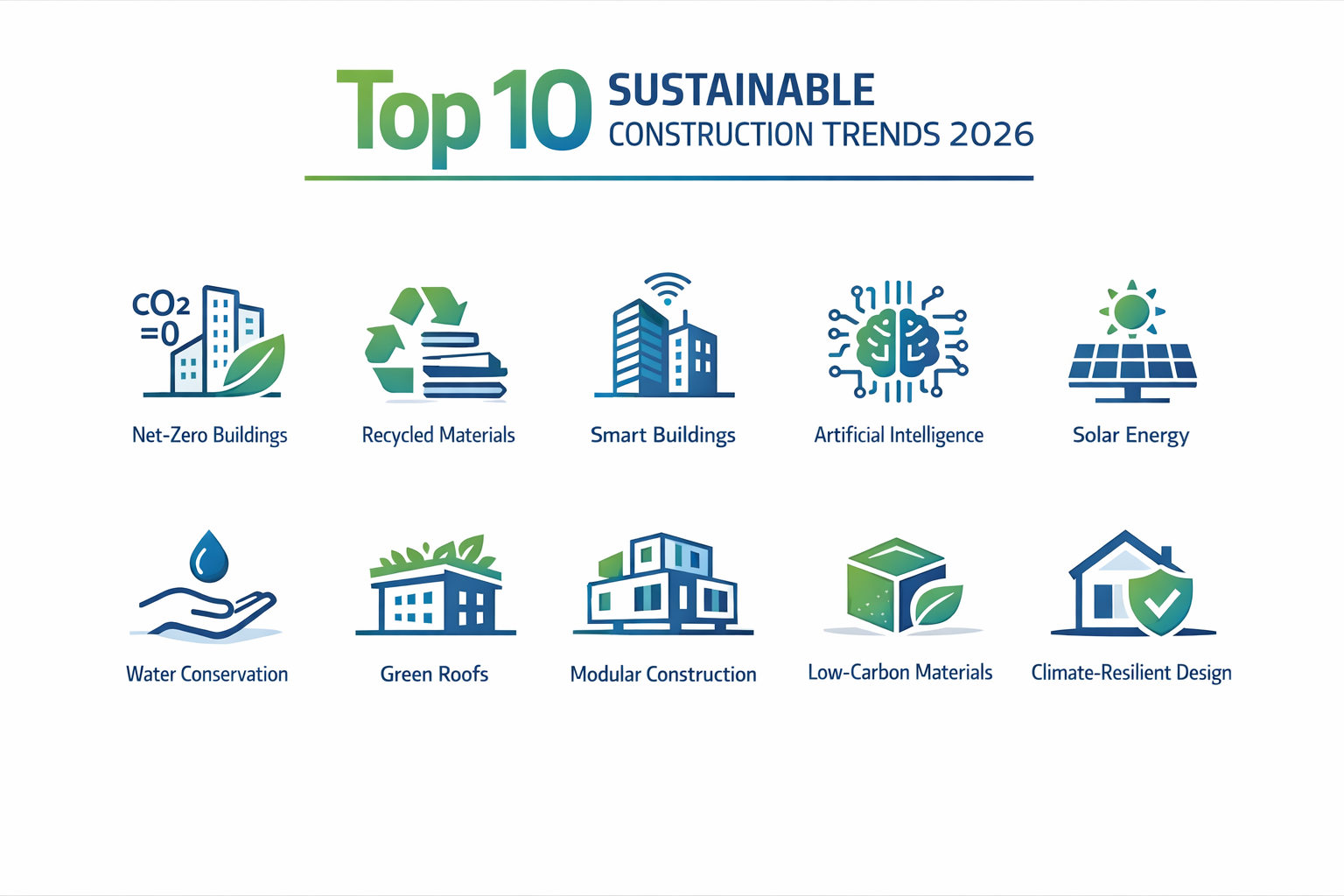
Top 10 Trends in Sustainable Construction 2026
The construction industry is undergoing one of the most significant transformations in its history. Long criticized for its environmental impact, the sector is now at the forefront of global sustainability efforts. Buildings and construction account for nearly 40% of global carbon emissions, making them a critical target in the fight against climate change (World Green Building Council).
As we move deeper into 2026, sustainability is no longer a “nice-to-have” feature—it is becoming the foundation of modern construction. From low-carbon materials to AI-driven design, the industry is embracing innovations that promise not only environmental benefits but also economic and social value.
In this blog, we explore the top 10 sustainable construction trends shaping 2026 and how they are redefining the future of the built environment.
1. The Rise of Net-Zero Buildings
Net-zero buildings—structures that produce as much energy as they consume—are quickly becoming the gold standard in sustainable construction. Governments, architects, and developers are increasingly aligning with stricter environmental regulations and climate targets.
These buildings rely on a combination of:
- High-performance insulation
- Energy-efficient systems
- Renewable energy sources such as solar panels
The shift is driven not only by environmental concerns but also by cost efficiency. Net-zero buildings significantly reduce operational expenses over time while minimizing environmental impact (Barge Design Solutions).
In 2026, net-zero is no longer experimental—it’s becoming mainstream.
2. Adaptive Reuse and Building Retrofits
One of the most impactful sustainability trends is the reuse of existing structures instead of building from scratch. Known as adaptive reuse or retrofitting, this approach dramatically reduces embodied carbon—the emissions associated with building materials and construction processes.
Studies show that renovation projects can cut embodied carbon by 50% to 75% compared to new builds (Forbes).
Examples include:
- Converting old warehouses into residential spaces
- Upgrading outdated office buildings into energy-efficient smart buildings
Rather than demolishing and rebuilding, developers are now asking: How can we improve what already exists?
3. Low-Carbon and Innovative Building Materials
Material innovation is at the heart of sustainable construction in 2026. Traditional materials like concrete and steel are being reimagined to reduce emissions and improve performance.
Some key advancements include:
- Calcined clay cement, which can reduce CO₂ emissions by up to 50% (Holcim)
- Carbon-capturing concrete
- Advanced composites with improved strength and durability (Kaizen)
In addition, bio-based materials such as bamboo and mycelium are gaining traction. These materials not only reduce carbon footprints but can also store carbon, making them a powerful tool in climate mitigation.
4. Circular Construction and Material Reuse
The concept of a circular economy is transforming construction practices. Instead of a linear “build-use-dispose” model, the industry is moving toward a system where materials are reused, recycled, and repurposed.
Innovations include:
- Recycling concrete into new aggregates
- Designing buildings for disassembly
- Using reclaimed materials in new projects
Advanced crushing technologies now allow old concrete to be reused in high-value applications rather than waste (Holcim).
This shift not only reduces waste but also conserves natural resources and lowers costs.
5. Smart Buildings and AI Integration
Technology is playing a crucial role in making buildings more sustainable. Smart buildings equipped with sensors, IoT devices, and AI systems can optimize energy use, water consumption, and indoor environments in real time.
Key technologies include:
- Building Information Modeling (BIM)
- Digital twins
- AI-powered energy management systems
These tools allow for predictive maintenance, energy optimization, and improved occupant comfort. AI-driven construction processes are also enhancing efficiency and reducing waste (Xpedeon).
In 2026, sustainability is as much about data as it is about design.
6. Renewable Energy Integration
The integration of renewable energy systems directly into building design is becoming standard practice. Solar panels, wind turbines, and geothermal systems are now commonly incorporated into both residential and commercial projects.
This trend reduces reliance on fossil fuels and helps buildings achieve energy independence. Solar integration, in particular, has become more seamless, with panels being embedded into roofs, facades, and even windows (www.dsrinfra.com).
As energy costs rise, renewable integration is not just environmentally responsible—it’s economically essential.
7. Climate-Responsive and Resilient Design
Climate change is forcing the construction industry to rethink how buildings are designed. Structures must now withstand extreme weather conditions such as heatwaves, floods, and storms.
Climate-responsive design focuses on:
- Passive cooling and heating
- Orientation for natural light and ventilation
- Resilient materials and construction techniques
Designing “in harmony with climate” is a key trend in 2026, ensuring buildings are both sustainable and durable (Trellis).
This approach is particularly important in regions experiencing rapid climate shifts.
8. Advanced Insulation and Energy Efficiency
Energy efficiency remains a cornerstone of sustainable construction. New insulation technologies are dramatically improving building performance.
Innovations include:
- Aerogels
- Vacuum insulation panels
- High-performance glazing systems
These materials significantly reduce heat transfer, lowering energy consumption for heating and cooling (NAWIC.ORG).
In hot climates like India, efficient building envelopes can drastically reduce cooling demands, making homes more comfortable and affordable to operate.
9. Water Conservation and Sustainable Resource Management
Water scarcity is becoming a global concern, and the construction industry is responding with innovative solutions.
Key practices include:
- Rainwater harvesting systems
- Greywater recycling
- Water-efficient fixtures and landscaping
Reducing freshwater usage is a growing priority, especially in regions facing water stress (Holcim).
Sustainable construction now considers not just energy, but all natural resources.
10. Performance Tracking and ESG Accountability
In 2026, sustainability is no longer about promises—it’s about measurable results. Developers and stakeholders are increasingly using data to track building performance and ensure compliance with environmental goals.
This includes:
- Carbon tracking tools
- Environmental Product Declarations (EPDs)
- ESG reporting frameworks
There is a growing demand for transparency and accountability, with standardized metrics helping organizations measure their environmental impact (World Green Building Council).
Buildings are no longer static structures—they are continuously monitored systems.
The Bigger Picture: A Holistic Shift
What makes 2026 unique is not just individual innovations, but the integration of all these trends into a cohesive system. Sustainable construction is evolving into a multidisciplinary effort that combines:
- Engineering
- Architecture
- Environmental science
- Data analytics
This holistic approach ensures that sustainability is embedded at every stage—from design and construction to operation and eventual reuse.
Challenges Ahead
Despite the progress, challenges remain:
- High upfront costs for sustainable technologies
- Lack of skilled professionals in green construction
- Regulatory inconsistencies across regions
However, these barriers are gradually being overcome through innovation, policy support, and growing market demand.
The Future of Sustainable Construction
Looking ahead, the future of construction will likely include:
- Buildings that generate more energy than they consume
- Fully circular construction ecosystems
- AI-driven autonomous construction processes
- Increased use of bio-based and carbon-negative materials
The industry is moving toward a vision where buildings are not just less harmful—but actively beneficial to the environment.
Conclusion
Sustainable construction in 2026 is no longer a trend—it’s a necessity. With climate change accelerating and urban populations growing, the need for environmentally responsible buildings has never been greater.
From net-zero buildings and circular materials to AI-powered systems and renewable energy integration, the industry is undergoing a profound transformation. These trends are not only reshaping how we build but also redefining what it means to create spaces for living, working, and thriving.
The message is clear:
The future of construction is green, intelligent, and resilient.
- Add SEO keywords + meta description
- Turn this into a LinkedIn article
- Add real-world case studies or Indian examples
- Create images/infographics for the blog